What's a good gratitude journal prompt when "three good things" feels stale?
By PlanJour team, Sparklithic Ltd · Published · Updated
The classic 'three good things' exercise is a solid starting point, but it can feel repetitive after a while. Here are prompts that dig a little deeper.
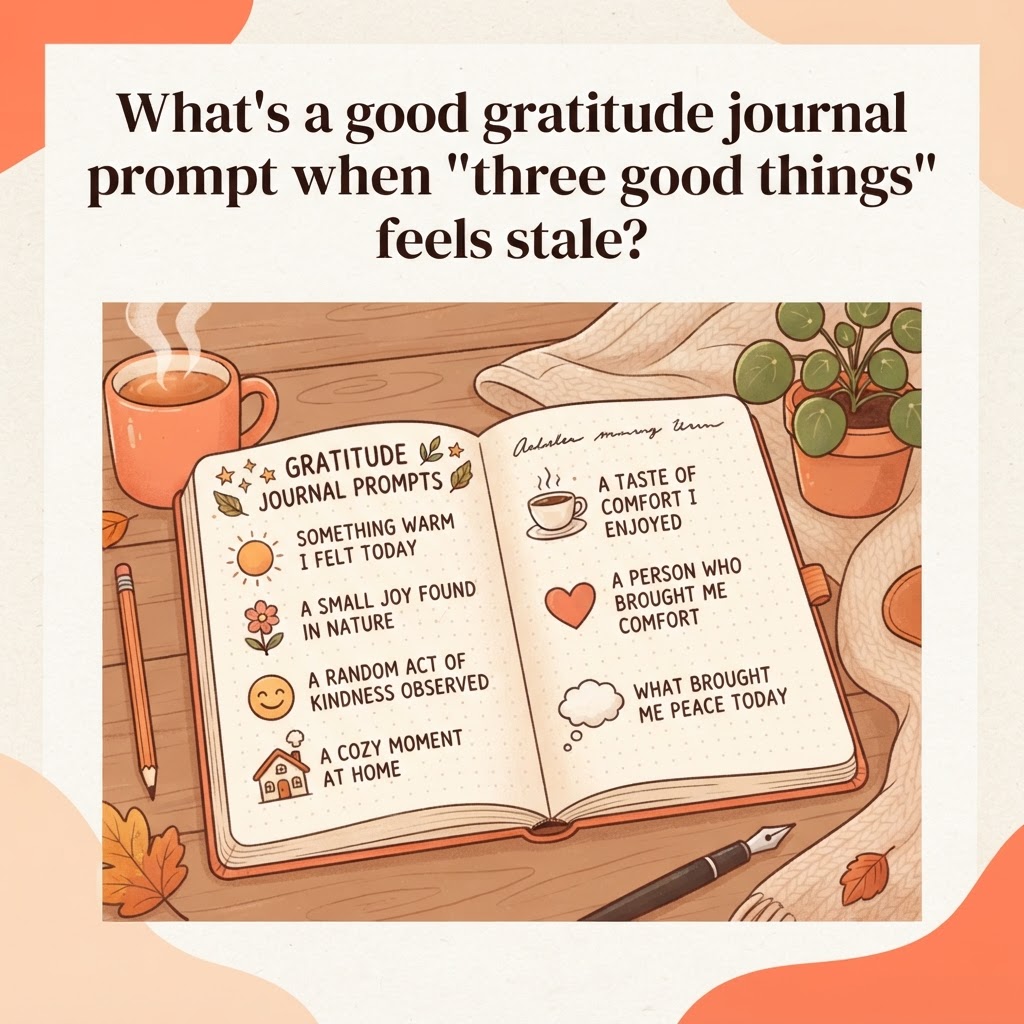
"Three good things" is a genuinely well-supported starting exercise, but after weeks or months, it's common to feel like you're writing the same generic answers on autopilot, family, health, coffee, without actually engaging with them. When that happens, the exercise has stopped doing much for you, and it's worth rotating in prompts that ask a slightly different question.
Prompts that ask for specificity instead of a general category
- What's one thing that went better today than you expected?
- Who made today slightly easier, and what did they actually do?
- What's something you'd have missed if it hadn't happened today?
These work because they force a concrete memory rather than a category you can answer the same way every day.
Prompts that look at avoided negatives, not just positives
- What's something that could have gone wrong today but didn't?
- What's a small inconvenience you didn't have to deal with today?
Gratitude for things that didn't happen is an underused angle, and it often surfaces things "three good things" misses entirely, since it's easy to only notice positives that actively happened, not problems that quietly didn't.
Prompts that connect gratitude to other people specifically
- Who are you grateful for today, and why specifically them?
- What's something someone said or did that you're still thinking about?
Gratitude tied to relationships tends to feel more meaningful on rereading later than gratitude tied to objects or circumstances.
Prompts that rotate the time frame
- What's something from this week, not just today, that you're glad happened?
- What's something you're looking forward to that you haven't appreciated yet?
Broadening beyond "today" occasionally can surface things a single day's lens misses.
A simple way to use these
Rather than trying to use a different prompt every single day, which becomes its own decision fatigue, pick three or four prompts you like and rotate through them weekly. Familiarity with a small set of prompts, refreshed periodically, tends to work better long-term than either always using the exact same one or constantly hunting for a new one.
The goal of rotating prompts isn't novelty for its own sake, it's keeping the exercise from becoming so automatic that you stop actually noticing anything. If "three good things" still feels genuine to you, there's no need to change it, but if it's started to feel like a chore you're filling in without thinking, a different angle can bring the exercise back to life.