How long does it actually take for a new habit to feel automatic?
By PlanJour team, Sparklithic Ltd · Published · Updated
The '21 days' claim isn't well supported. Here's what the actual research suggests, and why the range matters more than a fixed number.
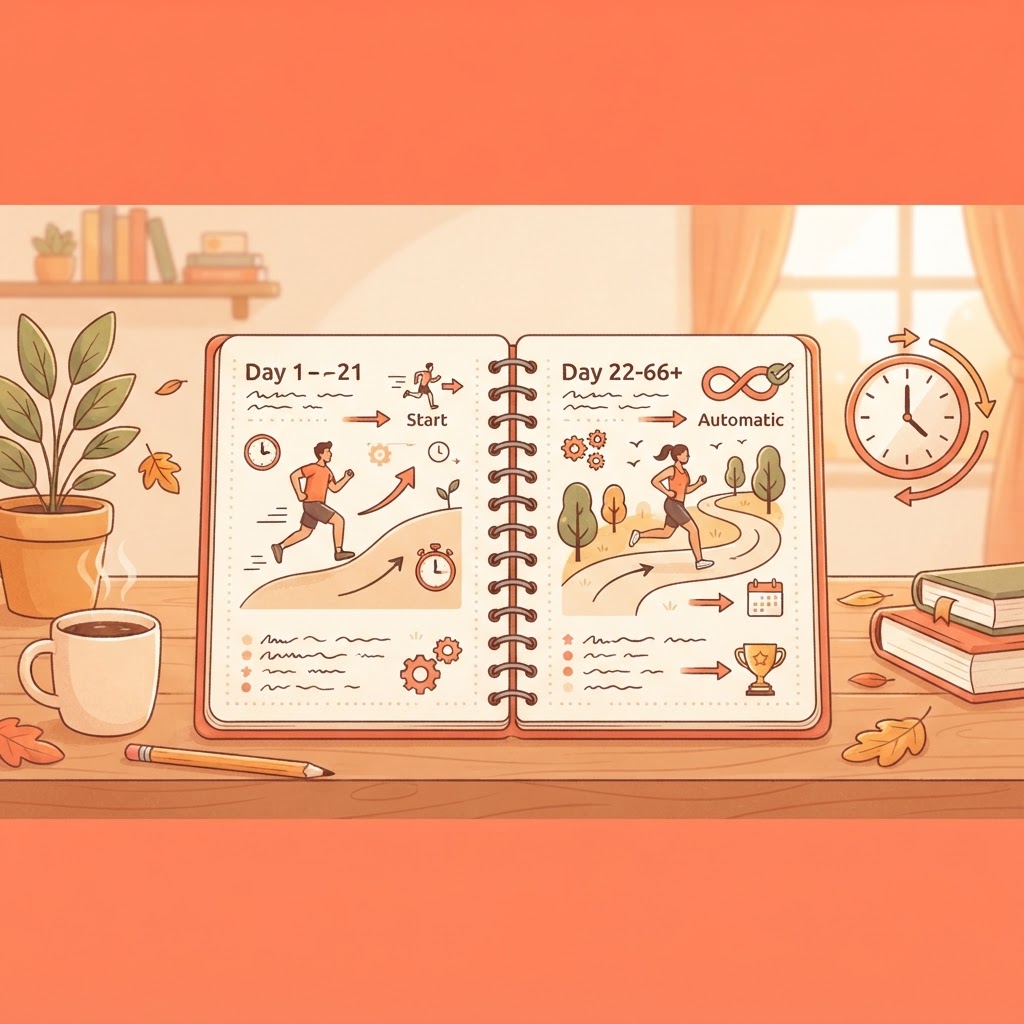
The commonly repeated "21 days" figure doesn't hold up well under scrutiny. It traces back to a 1960s observation about plastic surgery patients adjusting to appearance changes, not habit formation research, and it's been repeated so often it's treated as fact despite a weak original basis.
What actual research suggests instead
A widely cited study on habit formation found it took anywhere from 18 to 254 days for a new behavior to become automatic, with an average around 66 days, but with huge individual variation depending on the behavior itself and the person. Simple habits (drinking a glass of water after waking) formed faster than complex ones (a full exercise routine), and some people took far longer than others for the exact same habit.
Why the range is so wide
Habit formation depends heavily on how complex the behavior is, how consistently it's repeated, and how much friction stands between deciding to do it and actually doing it. A habit that's easy to do and tightly attached to an existing routine (journaling right after checking tomorrow's calendar) tends to solidify faster than one that requires more setup or willpower each time.
What this means practically
If you're expecting a habit to feel automatic by day 21 and it still requires effort, that's not a sign you're doing it wrong, it's within completely normal range. Giving up at three weeks because a habit "should" be automatic by then, based on a figure with no real scientific basis, throws away progress that was likely still on track.
Missed days don't reset the clock to zero
One missed day within a longer formation period doesn't erase the progress already made, occasional gaps were part of the original research data too, and habits still formed successfully around them. What matters more than a perfect streak is the overall frequency across the full formation period, not an unbroken run.
The practical takeaway
Expect somewhere between two and eight months for a new habit to stop requiring active effort, with real variation depending on the habit and the person. Treat the process as a matter of months, not weeks, keep the habit as low-effort as possible while it's forming, and don't read a slow start, or an occasional missed day, as evidence that it isn't working.