Why do I plan my week on Sunday and then completely abandon it by Wednesday?
By PlanJour team, Sparklithic Ltd · Published · Updated
A Sunday plan that falls apart by midweek usually isn't a discipline problem. It's a planning problem: no room for reality, and no checkpoint to adjust.
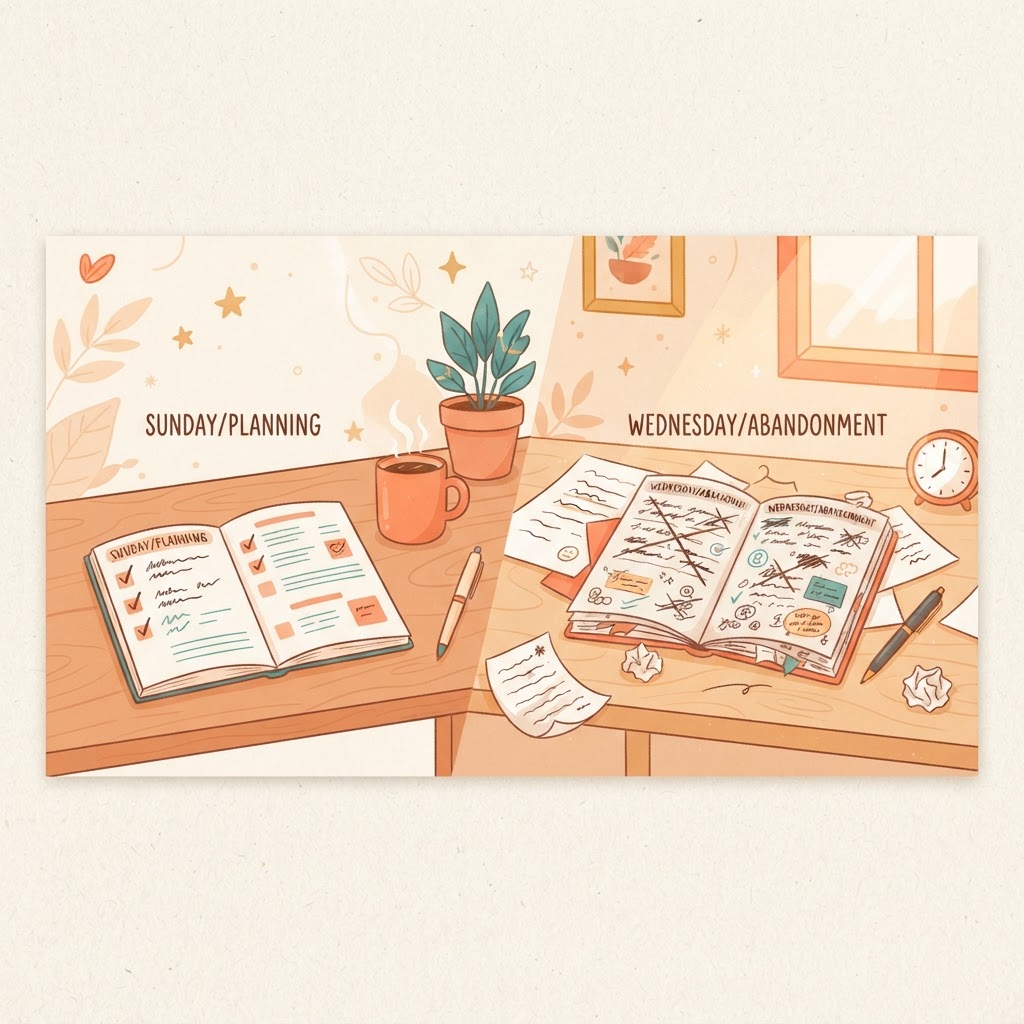
This is an extremely common pattern, and it's worth taking seriously rather than assuming it's a personal failing. A plan made once on Sunday, then never revisited, is fighting an entire week of unpredictable reality with zero opportunity to adapt. Of course it falls apart.
The Sunday plan is usually too optimistic
Sunday planning happens at the point of maximum optimism and minimum information, you don't yet know what Tuesday will actually throw at you. Plans made under those conditions tend to assume a smoother week than the one that actually arrives, which sets the plan up to feel broken the first time something unexpected comes up, even though a little friction is completely normal.
There's no scheduled moment to notice things have drifted
Without a deliberate midweek check-in, the first time you really notice the plan has fallen apart is often Wednesday or Thursday, when the gap between plan and reality has already become large enough to feel discouraging. By then, it can feel like too much has already gone wrong to bother adjusting, so the plan just gets abandoned rather than repaired.
Fix: build in a short midweek review
A two or three minute check on Wednesday, what's actually happened so far, what's changed, what needs to move, turns the plan into something living rather than a one-time Sunday artifact. This isn't about redoing the whole plan, it's a small course correction before things drift too far to easily recover.
Fix: leave deliberate slack in the original plan
A Sunday plan that schedules every available hour has no room to absorb even minor disruptions. Leaving a bit of intentional flexibility, an unscheduled block or two, means a normal amount of chaos doesn't automatically break the whole structure.
Fix: separate what's fixed from what's flexible
If your calendar clearly distinguishes actual fixed commitments (meetings, appointments) from more flexible intentions (errands, personal projects), it's much easier to see what genuinely needs to move versus what can simply slide without consequence when the week doesn't go as planned.
The real fix isn't more willpower on Sunday
It's treating the weekly plan as a draft that gets revisited, not a fixed contract made once and expected to survive five unpredictable days untouched. A short midweek look-back is a small habit that solves most of what makes Wednesday the point where plans quietly die.