How do I use recurring events for habits instead of a separate habit tracker app?
You don't necessarily need a separate habit tracker app. Here's how to use recurring calendar events to track habits without adding another tool.
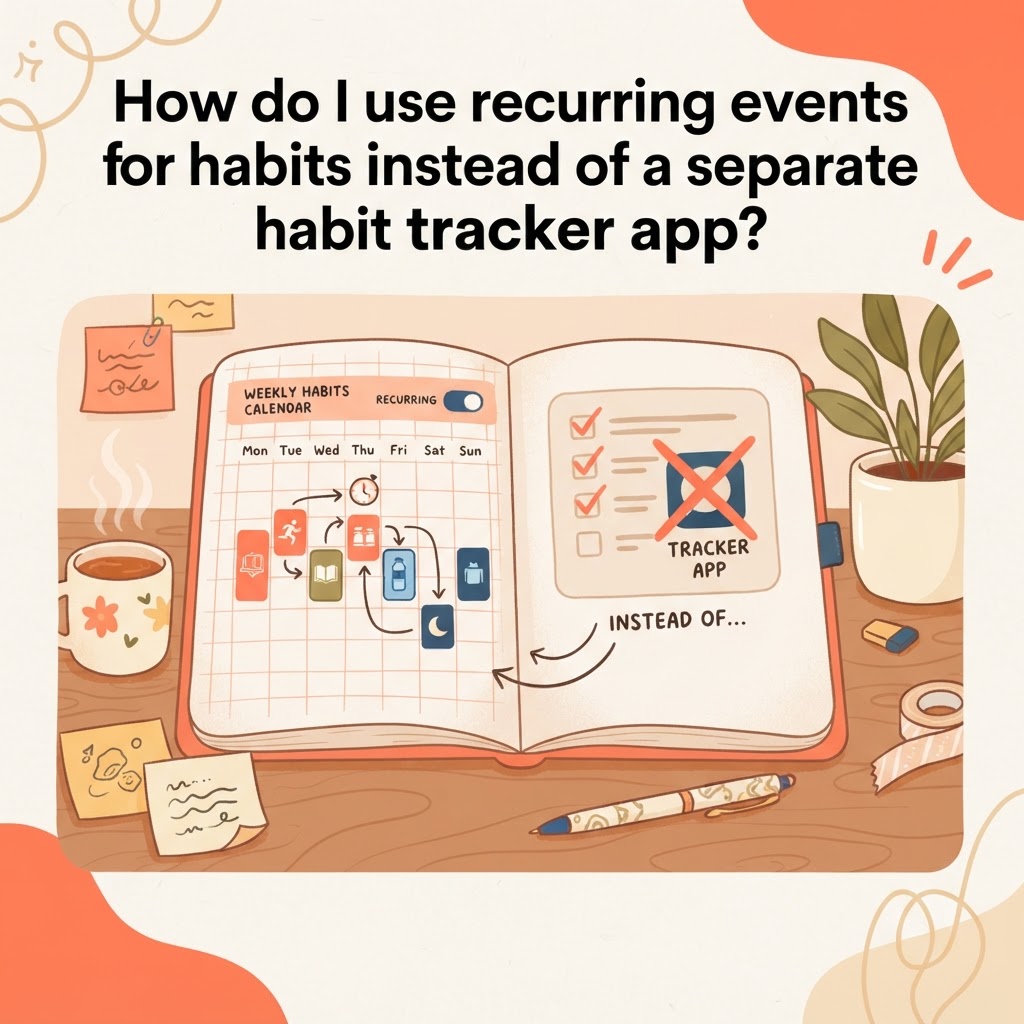
A lot of people default to a dedicated habit tracker app the moment they want to build consistency around something, but for many habits, a recurring calendar event does the same job without adding a new app to remember exists.
Set the habit up as a recurring event, at the time you actually intend to do it
Rather than a separate checklist item, put the habit directly on your calendar as a recurring event, same time, same days, whatever fits the habit. This gives it the same visual weight as any other commitment, rather than living in a separate list that's easy to forget checking.
Use a consistent sticker or color specifically for habits
Giving habit-related recurring events their own distinct visual marker, separate from work or personal categories, lets you glance at a week and immediately see which days you followed through and which you didn't, functioning much like a habit tracker's grid, just embedded in your existing calendar rather than a separate screen.
Mark completion in the notes or by simply seeing it pass
Some people like an explicit way to mark a habit done, jotting a quick note on the event, while others are fine simply glancing back at the week and seeing which days had the event actually acknowledged versus skipped. Either works, the key benefit is that the record lives on the same calendar as everything else, not in a separate app.
Why this beats a separate app for a lot of people
The core advantage isn't that recurring events are more powerful than dedicated habit trackers, specialized apps often have better analytics and streak visuals. It's that a habit living on the calendar you already check daily doesn't require remembering a second app exists at all, which is the single biggest reason standalone habit trackers get abandoned.
When a dedicated habit tracker still makes sense
If you're tracking many habits at once, or want detailed analytics and pattern-spotting across dozens of habits, a purpose-built tracker (or a tracker feature built directly into your journal, which some combined apps include) may serve you better than trying to cram everything into calendar events. But for one, two, or three key habits, recurring events on a calendar you're already checking are often the lower-friction, more sustainable choice, precisely because there's nothing new to remember.
Things that might help
Hand-picked by us and relevant to this article. Some are affiliate links, which means we may earn a small commission at no extra cost to you. We never use your journal, mood, habits or calendar to decide what appears here.

Audible
Affiliate linkHear something fascinating with our newest plan. Choose anything you want from our entire collection of 900,000 titles before your plan renews unused monthly selections won’t roll over to the next month.
Start Free 30 Day Trial
Skill Share
Creative Classes Taught by the Best Creative Pros. Stay Inspired Discover trending topics, get quick answers, and find your people.
Find your classKeep reading
- What's a good end-of-week reflection question if I only have two minutes?A weekly review doesn't need to be long to be useful. Here's a single question that works well when two minutes is genuinely all you have.
- Can journaling actually help with anxiety, or is that overstated?Journaling gets recommended for almost everything, which makes it easy to dismiss. Here's an honest look at what it can and can't do for anxiety.
- How do I stop double-booking myself across work and personal calendars?Running separate work and personal calendars is a common setup, and a common source of double-booking. Here's how to actually prevent it.