Why do ADHD brains do better with visual calendars than to-do lists?
A to-do list and a calendar contain the same information, but they're processed very differently. Here's why the visual format tends to work better for ADHD.
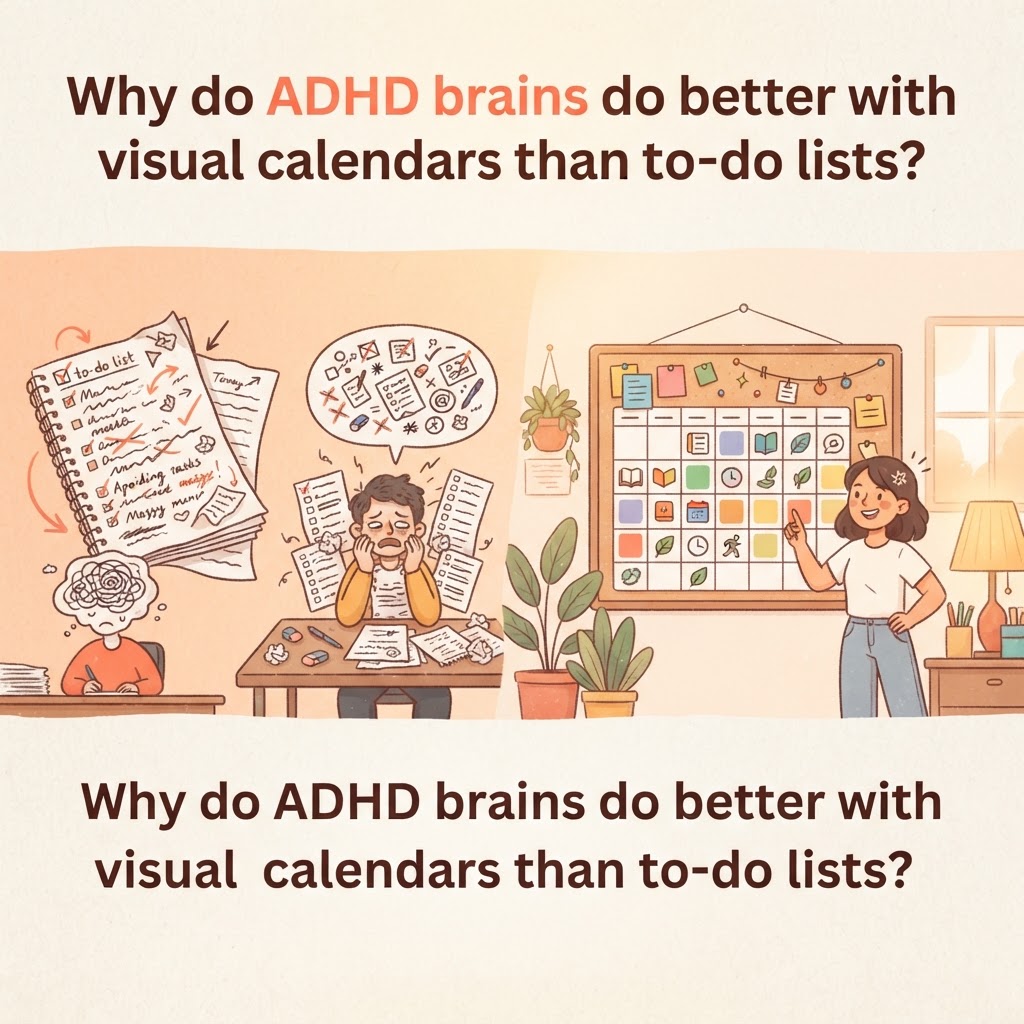
A to-do list and a calendar can technically hold the exact same tasks, but they're not equivalent in how the brain processes them, and that difference matters more for ADHD than it does for most people.
A flat list has no sense of time or space
A to-do list is just text, one line after another, with no visual indication of when something needs to happen or how much time it will actually take. Every item looks the same weight regardless of urgency. This is easy to skim past without anything really registering, which is a well-documented ADHD-relevant failure mode: information that doesn't stand out visually is information that's easy to not really see, even while looking directly at it.
A calendar block has size, position, and time built in
An event on a calendar takes up visible space proportional to how long it lasts, sits at a specific point in the day, and often has a color attached. That's a fundamentally richer object than a line of text, and it's much harder to skim past without registering, because it's not just information, it's a shape occupying part of a visual field you're already looking at.
Time blindness makes "when" more important than "what"
A common ADHD experience is a poor internal sense of how much time has passed or how much is left, sometimes called time blindness. A to-do list says what needs doing but says nothing about when or how long. A calendar directly addresses the part that's actually hardest to judge internally, giving an external, visual answer to "how much time do I actually have for this."
Color and category reduce decision load
A to-do list requires deciding, each time you look at it, what to do next and how urgent each item is. A color-coded calendar front-loads that decision: if it's red and it's happening in an hour, the calendar itself is telling you what matters right now, without you needing to actively evaluate the whole list again.
This doesn't mean to-do lists are useless
Flexible, undated tasks still need somewhere to live, and a general list works fine for those. The point isn't to abandon lists entirely, it's that anything with real time pressure benefits from being represented visually, on a calendar, rather than sitting as one more line in a list that's easy to read past without it landing. For ADHD specifically, that shift from text to visual space tends to make a bigger practical difference than most productivity advice acknowledges.
Things that might help
Hand-picked by us and relevant to this article. Some are affiliate links, which means we may earn a small commission at no extra cost to you. We never use your journal, mood, habits or calendar to decide what appears here.

Skill Share
Creative Classes Taught by the Best Creative Pros. Stay Inspired Discover trending topics, get quick answers, and find your people.
Find your class
Audible
Affiliate linkHear something fascinating with our newest plan. Choose anything you want from our entire collection of 900,000 titles before your plan renews unused monthly selections won’t roll over to the next month.
Start Free 30 Day TrialKeep reading
- How do I stop double-booking myself across work and personal calendars?Running separate work and personal calendars is a common setup, and a common source of double-booking. Here's how to actually prevent it.
- What's the difference between a habit tracker and a streak counter?These terms often get used as if they're the same thing, but a streak counter is really just one narrow feature within a broader habit tracker. Here's the distinction.
- How do parents keep track of kids' school events without missing things?School events come from a dozen different sources at once, emails, apps, paper notices, group chats. Here's how to bring them all into one place that actually works.