PlanJour for retirees
A calendar and journal for retirement
The diary emptied overnight, and that turned out to be the problem.
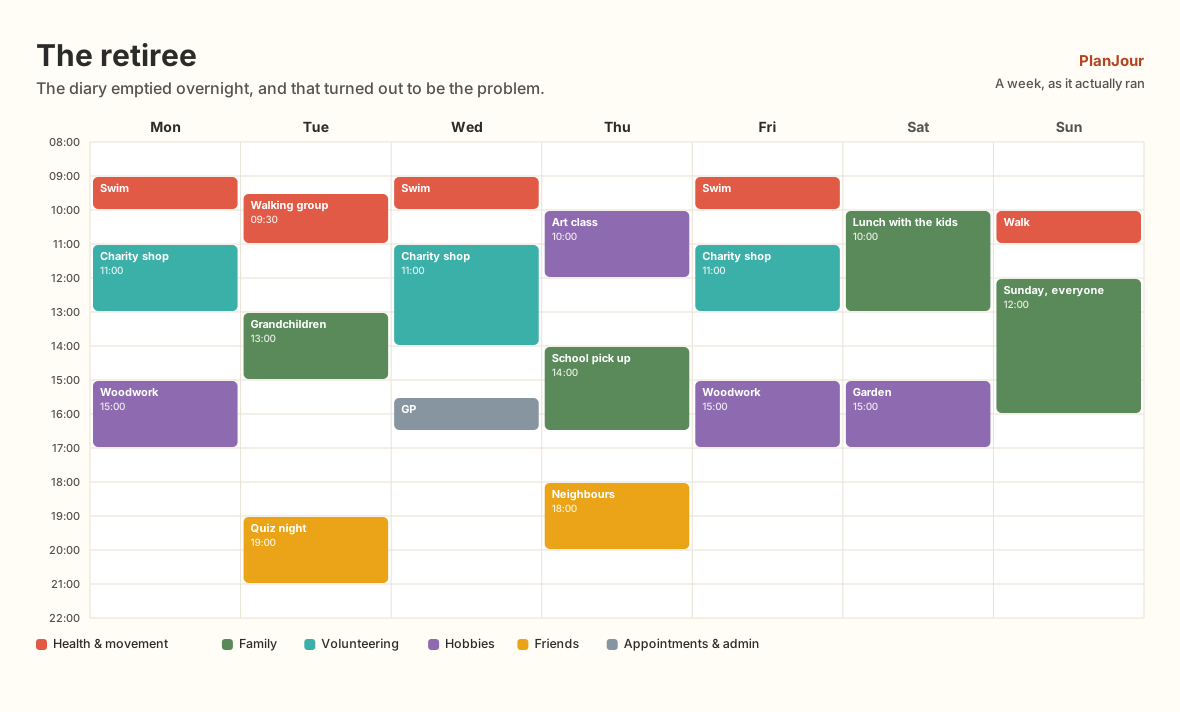
A week built on purpose, with nothing quietly dropping off it.
| Category | Hours | Share |
|---|---|---|
| Family | 11h 30m | 31% |
| Hobbies | 8h | 22% |
| Volunteering | 7h | 19% |
| Health & movement | 5h 30m | 15% |
| Friends | 4h | 11% |
| Appointments & admin | 1h | 3% |
| Scheduled that week | 37h |
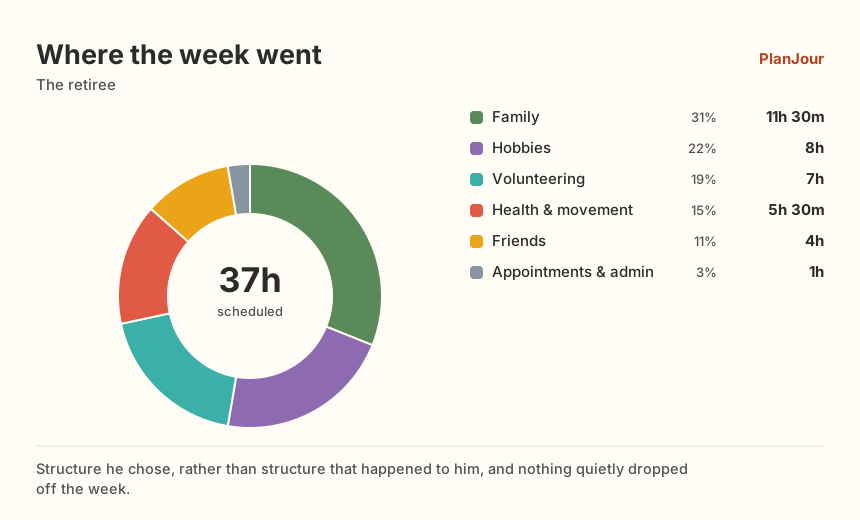
The opposite problem to every other page here
Fourteen of these fifteen case studies are about seeing an overload. This one is the reverse. A working diary is full whether you like it or not; a retired one is exactly as full as you decide to make it, and the drift from "free at last" to "the days blur" is well documented and fast. Thirty-seven hours of deliberate week is not a small number. It is a chosen one.
Structure you chose, not structure that happened
Swimming on Mondays, Wednesdays and Fridays. The charity shop three mornings. Art class on Thursday. Grandchildren twice. None of these are obligations and that is precisely why they need to be written down: the things with no external pressure behind them are the things that quietly stop happening, and nobody sends you an email when they do.
Noticing what has slipped
Four hours of friends this week. The allocation view over three months is where that number becomes meaningful, because the slide from four hours to two to none happens slowly enough to be invisible week by week. Social contact in later life is not a lifestyle preference; it is the thing most strongly associated with staying well, and it is the easiest category to lose without deciding to.
A journal with something to put in it
PlanJour is a calendar and a journal in the same place, which matters more here than on most of these pages. Days that are genuinely alike blur together in memory. One line and a photo a day is a modest amount of effort and, over a year, the difference between a period you remember and one you do not.
Setting this up in the first month after finishing work
The best time is immediately, while the shape of the old week is still in your head and before the days begin to resemble one another. Put in the things you already do (swimming, the charity shop, the grandchildren) as recurring events, and then deliberately add one thing per category that you have been meaning to start. Health, Friends, Hobbies, Volunteering, Family: five categories is plenty. Print the week for the fridge if that suits you better than a screen; it comes from the same place. Then look at the allocation view once a month, which is the interval at which a quietly vanishing category actually becomes visible.
What does the work here
Recurring commitments
The backbone of a chosen week, entered once.
Allocation over months
Spot the category that has quietly slipped.
Printable calendar
A paper week on the fridge, from the same source.
Daily journal with photos
Days that resemble each other need something to tell them apart.
Where PlanJour is the wrong choice
PlanJour is not a medication reminder or a care or health monitoring tool, and should not be relied on for either. It holds the shape of your week, not your health.
Questions
- Is it complicated to use?
- It is a calendar with a day, week and month view, and adding an event takes one tap. There is no team, no project, no workflow and nothing to configure before it works. Text size follows your device settings and it can be printed.
- Can I print my week?
- Yes. Any range can be exported as a PDF and printed, which several people use for a fridge copy alongside the app.
- Can family add things to my calendar?
- If you share a category with them, yes: useful for a family category where children and grandchildren can put in the things they are organising.
Other people, other weeks
Your week, as it actually ran.
Start free